Hotels offer an approachable way to read the Sunset Strip’s architecture. Their silhouettes, entrances, materials, and relationship to the hillside tell different stories from the signs advertising a night’s entertainment. You can begin noticing those details without arranging a specialist tour or entering a guest-only space.
Start by choosing two buildings that look distinctly different. Compare their shape from a public sidewalk, then read a reliable history afterward. Looking first helps you identify your own questions instead of searching only for the features a guide has told you to notice.
Use Sunset Tower as one architectural reference
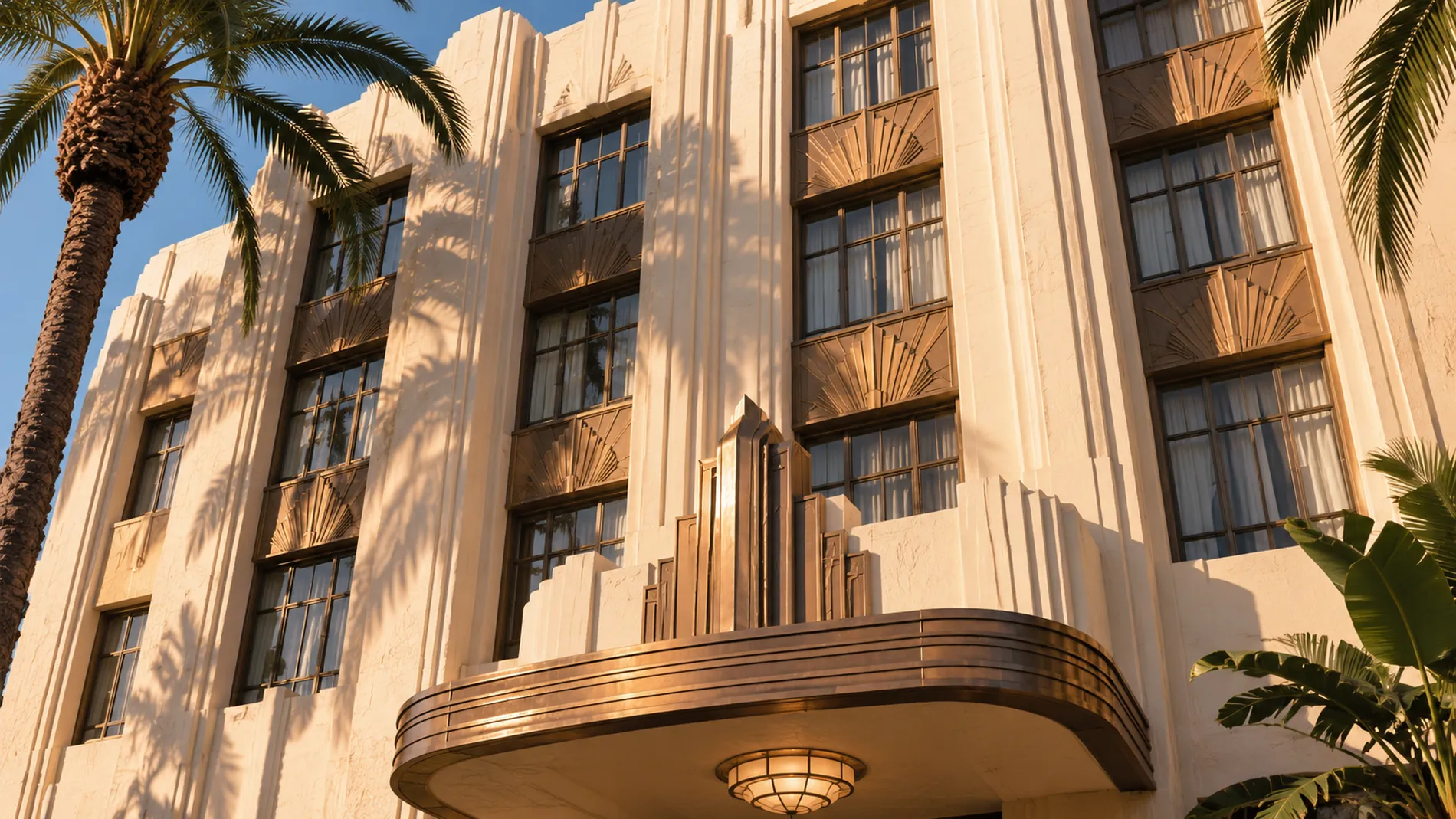
The Sunset Tower Hotel’s account of its history identifies architect Leland A. Bryant and a 1929 design date. It describes the building’s Art Deco styling and its earlier role as luxury apartments. Those few facts offer a useful lens: you are looking at a building whose identity has involved both residence and hospitality, rather than a structure conceived only as a contemporary overnight stop.
Study the vertical emphasis, the rhythm of windows, and the relationship between decorative surfaces and the main building form. You do not need to label every detail correctly. A short note such as “strong vertical lines and repeated windows” is more useful than attaching an architectural term you have not checked.
Notice how a hotel meets the boulevard
Look at the transition from public sidewalk to entrance. Does the building sit directly against the street, or does a driveway create distance? Is the arrival area visually prominent, or is the emphasis on the upper floors? How do landscaping, lighting, canopies, and changes in level guide a guest toward the door?
These are observations about design, not invitations to enter every space. Hotels have guests, service operations, and private areas. Stay on public routes unless you have a legitimate reason to enter, such as a confirmed reservation. Staff permission matters more than an assumption that a handsome lobby must be open for sightseeing.
Compare older forms with newer hospitality design
The Strip does not present a single architectural period. Part of the interest lies in comparing buildings designed for different expectations of luxury, visibility, and arrival. Look for the difference between a strong tower silhouette and a broad frontage, or between decorative ornament and large glazed surfaces.
Ask what the exterior promises. Does it suggest seclusion, spectacle, a social gathering place, or a view? Treat those answers as your interpretation rather than documented design intent. If you want to publish your observations, separate what you can see from what an architect or historical source actually states.
Keep history and renovation in separate columns
A date attached to a hotel can mean the date of design, construction, opening, a later rebranding, or a major renovation. Do not assume those are interchangeable. In your notes, record the event beside the date. That simple habit prevents a restoration story from becoming an inaccurate claim about when a building first appeared.
The city’s historic context document provides a broader research route when you want to move beyond an individual property’s presentation. Compare a building’s own account with preservation research, and be cautious with unsourced celebrity anecdotes. Architecture can be interesting without needing a dramatic story about every former guest.
Make an architectural walk comfortable and focused
Choose daylight for your first outing so details are easier to examine. Photograph from a stable position where you are not blocking a driveway, entrance, or pedestrian route. A wide view, one detail, and one written observation are often enough to remember a building without spending the entire visit behind a phone.
Pair your stops with a planned break and a realistic route back. Our Getting Around guides cover practical movement between destinations, while the History & Culture archive offers other ways to read the street. You can also repeat the same short route after dark to compare the lighting, provided you plan the return journey first.
The goal is not to judge which hotel looks most expensive or to assemble a list of celebrity associations. It is to understand how buildings contribute to the Strip’s atmosphere. Once you begin noticing scale, materials, entrances, and changes over time, the boulevard becomes a richer place to explore between meals, performances, and overnight stays.